 Canada (English)



















The Joy of Dentistry: Reclaiming the Chairside with Software Built for People
November 4, 2026
|6 min
Reframing dental innovation: why workflow friction, not clinical capability, is now the biggest constraint in modern practices
Let’s talk about how software actually makes you feel.
Yes, feel. This is not about features, functions, or which Large Language Model (LLM) it uses. It is certainly not about how fast it claims it can diagnose an issue in an ideal laboratory environment.
How does it feel to actually use it every single day in your dental practice or surgery? How does it feel for you and your colleagues? Is it joyful, or deeply frustrating?

The Shift in Digital Dentistry: From Diagnosis to Workflow
For years, innovation in dentistry has focused on improving clinical capability, with better imaging, faster scans, and more accurate diagnostics.
But in most practices today, clinical capability is no longer the only constraint—workflow efficiency now directly impacts productivity, capacity, and revenue potential. While faster scans and more precise diagnostics continue to matter, the quality of the workflow has become just as critical to delivering efficient, high-quality care.
The daily reality is still shaped by friction, including switching systems, re-entering data, and breaking the flow between clinician and patient. Over time, this friction reduces chair time efficiency, limits staff productivity, and detracts from the overall patient experience.
The next phase of digital dentistry will not be defined by what software can do, but by how little it gets in the way of what clinicians need to do, and how much it can augment their ability to deliver patient care and maximize revenue.

The Hidden Cost of Workflow Friction in Dental Practices
For too long, dental software has felt like a compromise. Teams invest in the latest technology to provide world-class care, yet frequently find themselves staring at loading bars, wrestling with separate logins, and double-entering patient data.
Information is copied and pasted. Files are saved and reloaded—all to view a single scan.
This is time that could and should be spent with patients—improving case discussions, increasing acceptance, and delivering a better overall experience.
Let’s be clear. Good software is the kind that fades into the background. The kind that does not create frustration. It simply works.
At its best, it becomes a genuine joy to use. A thoughtfully designed tool that supports clinical skills and frees up time, allowing clinicians to focus on the person in the chair and on higher-value activities that support practice growth.
When software is designed around the lived experience of the clinic, it stops being a utility and becomes a true enabler. It removes friction and gives teams time back to focus on practicing dentistry.

Software That Helps, Never Hinders
Imagine a busy Monday morning where technology flows naturally with the practice.
A clinician walks into the surgery with a tablet or checks a mobile device for lab updates between appointments, all on a single interface providing secure access to a unified patient view, where data and scans are available seamlessly across devices.
This is the direction modern dental software is moving towards, and the entire team benefits:
- Hygienist: No more rushing back to a fixed desktop or navigating complex menus just to check a detail before starting a session, saving time and improving appointment flow.
- Dentist: Greater freedom of movement, helping maximize chair time utilization and reduce delays between procedures. A scan or review can begin in the surgery and continue anywhere, without disruption.
- Patient: A more modern, seamless experience where the clinical team is present and engaged, rather than focused on navigating systems.
By bringing data together into a single, connected environment, the technical barriers to clinical excellence begin to disappear, with the technology adapting to the workflow, rather than forcing the workflow to adapt to the technology.

AI in Dentistry: Beyond Diagnosis to Operational Efficiency
There is so much noise around AI that it has become difficult to distinguish meaningful progress from novelty.
AI in dentistry is often framed purely as a diagnostic tool, but its greatest potential may lie elsewhere. When applied effectively, it can reduce the administrative and operational burden that sits behind every appointment—freeing up time, reducing manual input, and improving overall practice efficiency.
Within a connected ecosystem, AI-powered dental software can work quietly in the background, automating repetitive tasks that consume time and energy.
The value is not in adding complexity, but in removing effort. It’s enabling teams to focus on higher-value work that drives both patient outcomes and practice performance.

Transforming Patient Engagement Through Visual Workflows
One of the most significant shifts is in how patients engage with their care.
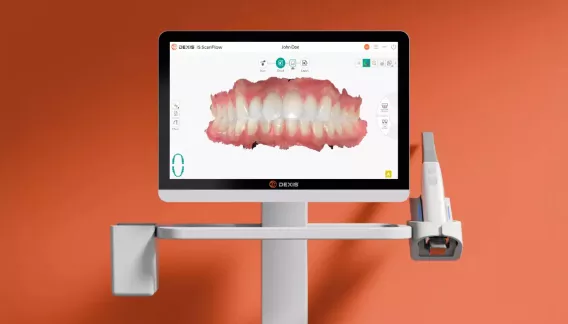
Dynamic visualizations, simulations, and clear reports allow patients to better understand their condition and treatment options.
When patients can see what clinicians see, the conversation changes. Understanding improves, confidence increases, and case acceptance naturally follows.

The Real Opportunity in Modern Dental Practices
The biggest opportunity in dentistry today is not better diagnosis. It is removing invisible work.
When workflows are simplified and information is presented clearly, collaboration between clinician and patient improves, while teams operate more efficiently and appointments run more smoothly. Patients can interact with their own data, review options, and feel more involved in decisions about their care.
This changes the dynamic entirely. Patients move from passive recipients to active participants—leading to stronger relationships, improved productivity, and more predictable practice growth. Conversations become clearer, more transparent, and more effective.
This, not just faster scans or isolated AI features, is what drives better outcomes, higher revenue, and less manual work.
The Future of Dental Practice Efficiency
The practices that succeed won’t be the ones with the most advanced tools.
They’ll be the ones where those tools disappear into the workflow, quietly removing friction, simplifying complexity, and giving clinicians their time back.
That’s the shift underway in digital dentistry.
Explore how DEXIS is building software designed to fit seamlessly into real clinical workflows.
DX02515_Rev00
Share This